


Cultivation • Genetics • Beginner's Guide
Seeds vs. Clones: The Ultimate Guide for Home Growers
Deciding between starting from scratch or skipping ahead? We take a deep dive into taproots, genetic vigor, the "dudding" epidemic, and the true cost of convenience.
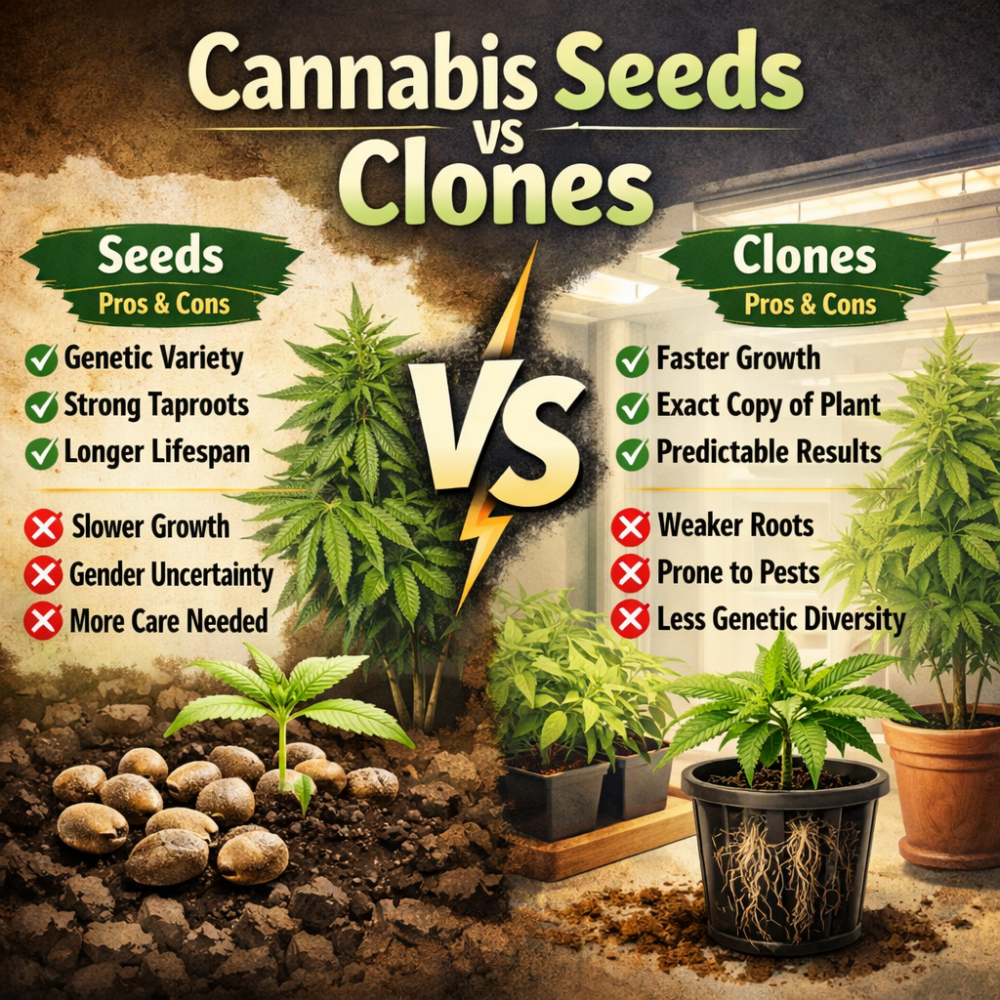
Image: The two paths every grower must choose between: the vigor of a seedling or the consistency of a clone.
TL;DR
- Seeds offer a "clean slate" free of pests and viroids, produce a strong taproot for better outdoor anchoring, and can be legally shipped almost anywhere. However, they take longer to start and have genetic variation (phenotypes).
- Clones are exact genetic copies of a mother plant, guaranteeing the sex and specific traits (flavor, yield) you want. They save 2-3 weeks of growth time but come with a high risk of pests and Hops Latent Viroid (HLVd).
- The biggest modern risk is HLVd ("dudding"), which is rampant in the commercial clone market. Seeds are generally considered safe from this.
- Cost: Seeds are cheaper upfront per plant; verified clean clones are expensive ($50–$500+).
- Verdict: Beginners and outdoor growers should stick to seeds for vigor and safety. Advanced indoor growers seeking specific production metrics often prefer clones but must quarantine rigorously.
The Great Debate: Nature vs. The Xerox Machine
In the world of cannabis cultivation, few choices are as fundamental as the decision between starting from seeds or clones. It is the very first fork in the road, and the path you choose dictates your timeline, your budget, your risk exposure, and ultimately, the quality of your harvest.
For decades, the conventional wisdom was simple: commercial growers used clones for consistency, while home growers used seeds because they were easier to get. But the landscape has shifted dramatically. With the legalization of hemp and the explosion of the "breeder cut" market, home growers now have access to elite genetics that were once kept under lock and key. Conversely, the rise of devastating pathogens like Hops Latent Viroid (HLVd) has turned the clone market into a minefield.
So, do you trust nature’s design and pop a bean, or do you trust the "Xerox machine" of biology and buy a cut? To answer that, we have to look beyond just the convenience and dig into the biology of the plant itself.
The Case for Seeds: Vigor, Cleanliness, and the Taproot
There is something primal about starting from seed. It is agriculture in its purest form. But beyond the romanticism, there are distinct physiological advantages to seed-grown plants that clones simply cannot match.
1. The Taproot Advantage
When a cannabis seed cracks open, the first thing to emerge is the radicle, which dives straight down into the soil to become the taproot. This central anchor is the superhighway of the plant's root system. It dives deep, seeking out moisture and stability.
Clones never develop a taproot. Because they are rooted cuttings from a branch, they develop a fibrous root system—a shallow web of secondary roots. While fibrous roots are excellent for nutrient uptake in hydroponic systems, they lack the structural integrity of a taproot.
Why this matters: If you are growing outdoors, a seed-grown plant will anchor itself better against the wind and reach deeper into the water table during droughts. They are, quite literally, more grounded.
2. The "Clean Slate" Protocol
This is the most critical argument for seeds in the modern era. A seed is a biological vault. It is incredibly difficult for pests like spider mites, russet mites, or aphids to hitch a ride inside a seed shell. Furthermore, most viruses and viroids (including the dreaded HLVd) generally do not transmit efficiently through seed (though rare exceptions exist, the transmission rate is negligible compared to vegetative propagation).
When you pop a seed, you are starting with a clean slate. You don't have to worry that the grower before you used banned pesticides or had a thrips infestation. You control the environment from Day 1.
3. Hybrid Vigor
Seedlings often display "hybrid vigor" (heterosis), growing with an explosive energy that clones—which are genetically the same age as the mother plant, potentially years old—sometimes lack. A clone from a 5-year-old mother plant carries the cellular age of that mother. A seed is brand new life.
The Case for Clones: Consistency is King
If seeds are the wild, exciting route, clones are the professional, predictable route. A clone is a genetic duplicate of its mother. If the mother tasted like blueberry muffins and finished flowering in 56 days, the clone will taste like blueberry muffins and finish in 56 days.
1. Predictability
With seeds, you are dealing with a family. If you plant 10 seeds of "Blue Dream," you might get three that are tall and stretchy, three that are short and bushy, and four that are somewhere in between. This is phenotypic variation.
For a home grower with a small tent, this can be annoying. If one plant grows 12 inches taller than the others, it gets too close to the light while the others are in the shade. With clones, the canopy is perfectly even. Every plant feeds the same, drinks the same, and stretches the same.
2. Saving Time
Germinating a seed and nursing it through the delicate seedling stage takes about 2–3 weeks. A purchased clone is already rooted and essentially a miniature adult plant. You skip the infant mortality stage entirely. If you are running a perpetual harvest cycle where time is money, shaving off three weeks is massive.
3. Guaranteed Female
While feminized seeds have largely solved the issue of male plants, they aren't 100% perfect. Regular seeds require you to sex the plants and cull the males. Clones are always female (assuming the mother was female). You never have to worry about a male pollination event ruining your crop.
The Hidden Dangers: HLVd and the "Dirty" Market
This section is the most important part of this guide. If you skipped here, read carefully. The cannabis clone market is currently facing a silent epidemic: Hops Latent Viroid (HLVd).
HLVd is a pathogen that causes "dudding." An infected plant often looks normal in the vegetative stage. But once you flip to flower, the nightmare begins. The branches grow brittle and snap horizontally. The buds fail to develop trichomes and remain small, hard, and scentless. The potency can drop by 50% or more.
The scary part? You cannot see HLVd with the naked eye until it's too late. It spreads through mechanical contact—clippers, scissors, even touching an infected leaf and then touching a healthy one. Because commercial clone nurseries process thousands of plants, if their sanitation isn't hospital-grade, they can unknowingly ship thousands of infected clones.
The Clone Rule: If you buy clones, you must quarantine them. Do not put a new clone into a tent with your existing plants immediately. Ideally, you should send a tissue sample to a lab (like Tumi Genomics or similar) to test for HLVd before letting it near your garden. This costs money ($25-$50 per test), but it saves your crop.
Seeds, by comparison, are the biosecurity gold standard. They do not carry the systemic pest load of a mother plant.
Legal Status and Shipping in 2026
The legal landscape has shifted in favor of the consumer, but it is still complex.
Seeds: Thanks to the 2018 Farm Bill and subsequent DEA clarification letters, cannabis seeds are federally considered "hemp" as long as they contain less than 0.3% Delta-9 THC on a dry weight basis. Since seeds contain no THC (the THC develops in the flowers later), they are legal to ship across state lines in the US. You can buy them with a credit card and have them mailed to your door without fear.
Clones: This is a grayer area. Many nurseries ship clones openly, arguing that because the vegetative clone has less than 0.3% THC, it is also hemp. However, shipping live plants is subject to agricultural laws regarding pests and soil pathogens. Furthermore, if a clone is seized, it looks like a marijuana plant, whereas seeds look like birdseed. While you likely won't go to jail for ordering a clone, the risk of seizure or package loss is significantly higher than with seeds.
The Cost Analysis: Time vs. Money
Let's break down the economics for a typical 4-plant home grow.
| Factor | Seeds (Feminized) | Clones (verified clean) |
|---|---|---|
| Cost per Unit | $10 - $20 | $30 - $100+ (plus shipping) |
| Start Time | +2-3 weeks (germination) | Immediate veg |
| Sanitation Costs | $0 | $30-$50 (HLVd test recommended) |
| Risk | Low (might get a runt) | High (pests/viroids could ruin whole crop) |
While seeds require more patience, they are significantly cheaper. Buying a "breeder cut" clone of a hype strain (like a verified Cap Junky or Permanent Marker cut) can cost upwards of $200-$500 per cutting. A pack of seeds from the same breeder might cost $150 for 10 seeds.
Pheno-Hunting: The Joy of Discovery
There is one intangible benefit to seeds: the hunt. When you buy a clone, you are growing someone else's winner. You are covering a hit song.
When you pop a pack of seeds, you are looking for your own winner. You might find a plant that leans heavily toward a rare terpene profile that the breeder didn't even intend. You might find a "unicorn" phenotype that yields double the others. This process is called pheno-hunting. For many hobbyists, this discovery process is the hobby. Naming your own keeper cut ("Steve's Lemon Wreck") provides a sense of ownership that buying a clone never will.
Conclusion: Which Path is Right for You?
Choose Seeds If:
- You are a beginner (start clean, learn the whole lifecycle).
- You grow outdoors (need that taproot strength).
- You are on a budget.
- You are worried about pests, mites, or HLVd.
- You enjoy the surprise and variety of different phenotypes.
Choose Clones If:
- You are an advanced grower with a strict schedule.
- You need an even canopy for a Sea of Green (SOG) setup.
- You want a specific, verified strain (e.g., "I want the exact Runtz cut from 2020").
- You have the ability to quarantine and test for viruses.
Ultimately, both paths lead to the same destination: a jar full of homegrown flower. But for the vast majority of home growers in 2026, the safety and vigor of seeds make them the smarter bet. Let the commercial guys fight the viroids; you just pop a bean and watch nature do the work.
Frequently Asked Questions
Do clones yield less than seeds?
Not necessarily, but they can. Because clones lack a taproot, they may not feed as aggressively in large outdoor soil beds. However, indoors, where nutrients are force-fed, clones can yield just as much as seed plants.
Can I turn a seed plant into a clone?
Yes! This is the best of both worlds. You can pop a seed, grow it out, and if you love it, take cuttings from it to preserve the genetics. This is how you create your own "mother plant."
What is a "selfed" (S1) seed vs. a clone?
An S1 seed is made by reversing a female clone to pollinate itself. The resulting seed will be very similar to the mother clone, but not identical. It will still have some genetic variation. Only a clone is a 100% exact copy.
How do I spot HLVd on a clone I just bought?
You often can't. The plant may look healthy (latent) until stress or flowering triggers symptoms. The only way to be sure is to use a molecular test kit (PCR test) available from agricultural labs.
Is it illegal to order clones in the mail?
It is a legal gray area. While the 2018 Farm Bill legalizes hemp (