


Cannabis Cultivation • Legal • Compliance
Navigating the Green Tape: Legal Requirements for Buying Cannabis Clones
Buying seeds is easy, but buying live plants is a legal minefield. Here is your comprehensive guide to the federal gray areas, state plant limits, and the risks of "mail-order" genetics.
)
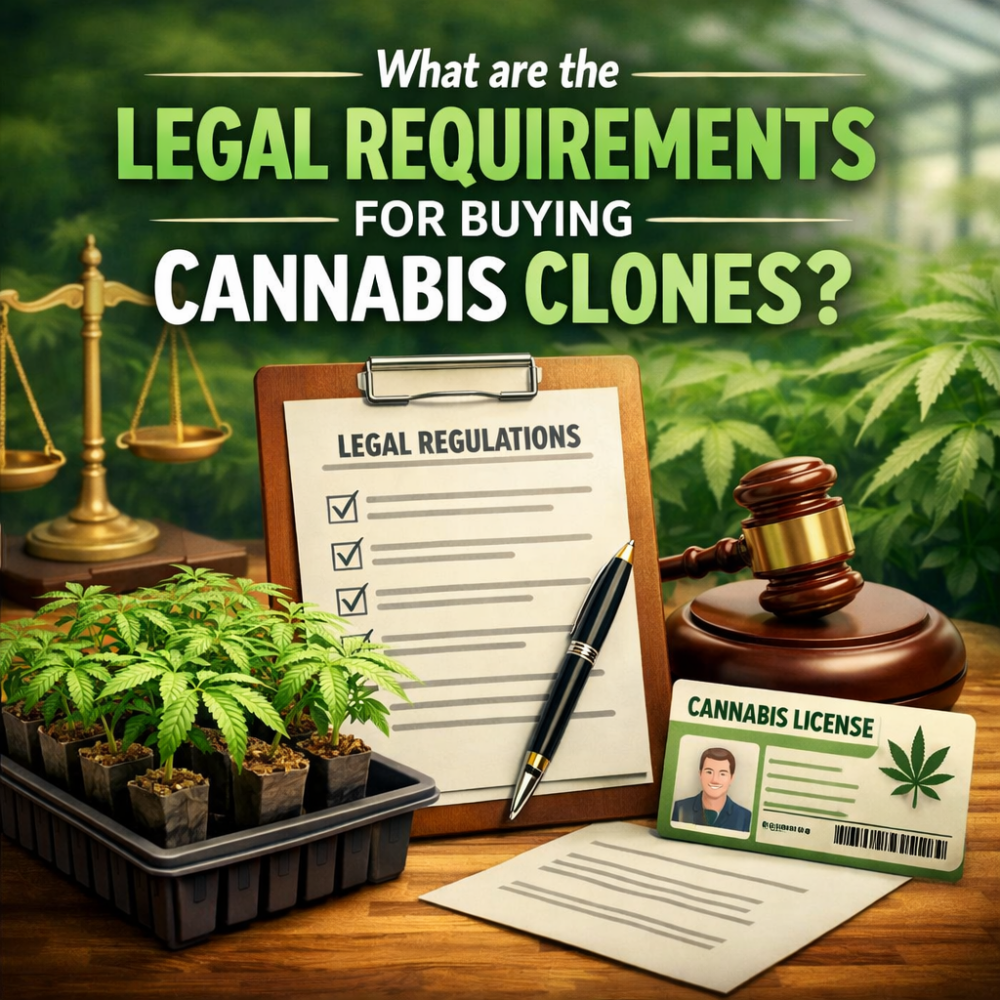
Image: Immature plants (clones) sit in a legal gray area between "hemp" and "marijuana."
TL;DR
- Federal Status: Live clones are federally illegal if they are "marijuana," but many are sold as "hemp" under the 2018 Farm Bill if they have
- State Limits: In legal recreational states, you are typically limited to buying 6 to 12 immature plants at a time.
- Transport: Crossing state lines with clones is a federal felony, even between two legal states (e.g., California to Oregon).
- Online Sales: A booming "mail-order" market exists using the hemp loophole, but shipping live cannabis plants carries significant seizure risks.
- Identification: You generally need a valid government ID showing you are 21+ (or 18+ with a medical card) to purchase from a dispensary.
- Liability: Once the plant flowers and produces THC, it is legally your responsibility to ensure it complies with your local home-grow laws.
Clones vs. Seeds: The Legal Distinction
For years, home growers operated on the "don't ask, don't tell" policy of finding bag seeds. Today, you can walk into a dispensary and buy a genetic duplicate of a high-times cup winner. But the law treats seeds and clones very differently.
In 2022, the DEA issued a clarification that cannabis seeds are considered "hemp" if they contain less than 0.3% Delta-9 THC. Since seeds contain almost zero THC, this effectively legalized the trade of seeds across the US.
Clones, however, are live plants. They are cuttings from a mother plant that have rooted. While they are usually in a "vegetative" state (meaning they aren't producing buds yet), they do have leaves, stems, and existing cannabinoids. This makes them legally riskier than seeds. If a clone is taken from a high-THC mother, does it count as hemp or marijuana? The answer depends on who you ask—and where you are standing.
The "Hemp Clone" Federal Loophole
This is the most confusing part of the current market. You will see websites selling "Farm Bill Compliant Clones" shipped to your door in all 50 states. How is this possible?
The 2018 Farm Bill defines "hemp" as any part of the Cannabis sativa L. plant with a Delta-9 THC concentration of not more than 0.3% on a dry weight basis.
The Argument for Legality: Most clones in the vegetative stage have very low THC levels. They haven't started flowering, so they don't have the resin glands that pump out the psychoactive chemicals. Sellers argue that because the clone tests below 0.3% Delta-9 THC at the time of sale, it is legally hemp—even if it is genetically destined to become 25% THC "Godfather OG" in three months.
The Risk (The "Total THC" Rule): Federal regulators are catching on. Many states and updated USDA rules now require testing for "Total THC" (which includes THCa). While veg plants are still usually low in THCa, some aggressive strains might test "hot" (above 0.3%) even as babies. Furthermore, the DEA has stated that the intent matters. If you are growing a plant intended to produce high THC marijuana, it may be treated as such regardless of its current chemical composition.
State-by-State Purchase Limits
If you want to stay 100% compliant, you buy your clones in person at a licensed dispensary in a legal state. But even then, there are strict limits on how many you can take home.
These limits generally fall into two categories: Recreational (Adult Use) and Medical.
)
Recreational Limits (The "Six Plant" Standard):
Most recreational states allow adults to possess or purchase a specific number of immature plants.
- California: You can typically buy up to 6 immature plants (clones) per day. Note that some municipalities ban outdoor growing entirely, so check your local city ordinances.
- Colorado: The state limit is 6 plants per person (with up to 3 flowering), but households are often capped at 12 total plants regardless of the number of adults.
- New York: Adults can home grow up to 3 mature and 3 immature plants, with a household cap of 6 mature and 6 immature (12 total).
- Michigan: One of the most generous states, allowing up to 12 plants per household.
Medical Exemptions:
Medical cardholders often enjoy much higher limits.
In California, a patient with a doctor's recommendation can sometimes grow as many plants as is "reasonably necessary" for their condition (often interpreted as high as 99 in specific legal defenses, though 6-12 is standard). In Colorado, patients can apply for an "extended plant count" to legally purchase and grow far more than the recreational limit.
The Transaction: ID, Cash, and Tracking
When you walk into a dispensary to buy a clone, the process is more rigorous than buying a tomato plant at Home Depot.
1. Identification is Non-Negotiable: You must present a valid government-issued ID proving you are 21+ (or 18+ with a valid medical card). Expired licenses will get you turned away.
2. The "Daily Limit" Calculation: In many states, clones count toward your daily purchasing limit. For example, if your state allows you to buy 1 ounce of flower or 6 clones, you usually cannot buy both the maximum flower amount and the clones in the same transaction. The point-of-sale system will track your "equivalency" to ensure you don't exceed the legal possession limit.
3. Seed-to-Sale Tracking (Metrc): Legally purchased clones will come with a tag or label. This is part of the state's "seed-to-sale" tracking system (often software called Metrc). Pro Tip: Do not remove this tag until you get the plant home. It is your proof that the plant was purchased legally and taxes were paid.
Transporting Your Clones Home
The most dangerous part of buying clones is the drive home.
The Golden Rule: No Interstate Travel It does not matter if you are driving from Oregon to Washington, or California to Nevada. Transporting cannabis across state lines is a federal felony (drug trafficking). Federal law does not recognize state boundaries when it comes to "interstate commerce" of controlled substances.
In-State Transport Rules: Even within your legal state, you must follow specific transport laws:
- Out of Sight: Plants should not be visible from the outside of the vehicle. Don't buckle them into the passenger seat.
- Trunk is Best: To avoid "open container" laws (which can apply to loose cannabis products), place clones in a sealed box in the trunk or the furthest area from the driver.
- Odor Control: Clones can smell "green" and skunky even in veg. If you get pulled over for speeding and the officer smells fresh cannabis, they have probable cause to search your vehicle.
The Risks of Buying Clones Online
A quick Google search will reveal dozens of nurseries offering to ship "elite cuts" to your doorstep via UPS or FedEx. Is this legal?
The Reality: These sellers are operating on the "hemp loophole" described earlier. They ship with a "Notice to Law Enforcement" and a Certificate of Analysis (COA) showing
The Risks You Take: 1. Seizure: Postal inspectors and private carriers (FedEx/UPS) are becoming more aggressive. If they suspect the package contains marijuana, they can seize and destroy it. FedEx has a zero-tolerance policy for hemp ingestibles and often extends this to plants. 2. "Hot" Plants: If the clone was stressed during shipping and produced a tiny bit of THC, it could technically test as marijuana upon inspection. 3. Scams: The online clone market is rife with fraudsters who take your Bitcoin and send you nothing, or send you a generic hemp plant instead of the "Runtz" cut you paid $500 for.
If you choose to buy online, you are strictly operating in a "buyer beware" gray market. It is rarely prosecuted against the buyer (small personal amounts are usually just confiscated), but you risk losing your money.
Frequently Asked Questions
Can I buy clones if I live in a state where growing is illegal?
No. Even if you buy a "hemp compliant" clone online, once it arrives in your state and you begin cultivating it with the intent to produce marijuana, you are violating state manufacturing laws. In strict states (like Idaho or Kansas), this can lead to severe criminal penalties.
Do I need a medical card to buy clones?
In "Recreational/Adult-Use" states (like CA, CO, OR, MI, NY), you only need a valid 21+ ID. In "Medical-Only" states (like OK, MO medical program), you must present your state-issued medical marijuana patient card.
Can I fly with cannabis clones?
Absolutely not. The TSA is a federal agency. Airspace is federal jurisdiction. Taking cannabis on a plane is a violation of federal law, even if you are flying between two legal states.
What is the difference between a "clone" and a "tissue culture"?
A clone is a macro-cutting from a plant. Tissue culture is a micro-propagation method done in a sterile lab. Legally, they are treated similarly (live plants), but tissue culture is often cleaner (disease-free) and is the preferred method for shipping by large legal nurseries.
Do clones count as "plants" or "concentrates"?
They count as Immature Plants. They generally do not count against your "flower" possession limit (e.g., you can have 1 oz of weed AND 6 clones), but they DO count against your home cultivation limit (e.g., if you are allowed 6 plants total, you cannot have 6 flowering plants + 6 clones).
What if my clone dies? Can I return it?
This depends on the dispensary's policy. Most dispensaries have a "no return" policy on plant material due to the risk of introducing pests (like spider mites) back into their facility. Inspect your clones thoroughly for bugs and mold before you leave the shop.