

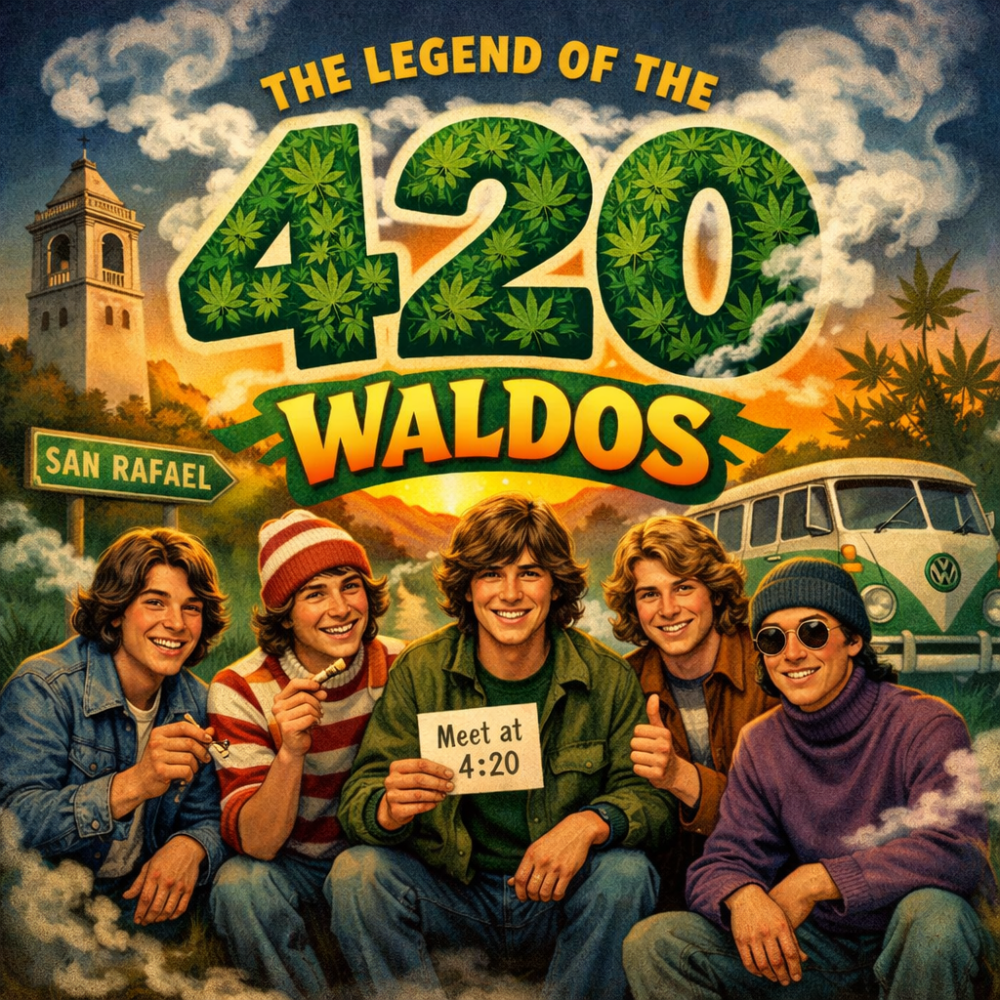

Where 4/20 Actually Came From (And What It Used to Mean)
I remember the first 4/20 I actually paid attention to. Someone older had a crumpled flyer, a drive planned, and a weird seriousness about it that I didn’t fully understand at thirteen. Nothing about it had been advertised. There was no press release. Just a date, a time, a hillside, and a pretty clear assumption that you either knew or you didn’t.
That’s not really how 4/20 works anymore. This year I saw an ad for 4/20 on the side of a city bus, right next to an ad for a hospital. A dispensary near me is running a “BOGO pre-roll brunch” with bottomless mimosas. A wellness brand I’d never heard of is hosting a 4/20 “infused sound bath.” My delivery app pushed a notification offering me twenty percent off and a free grinder. It’s a lot.
None of this is a complaint, exactly. Weed is legal where I live. The fact that a plant I once knew as contraband in a Ziploc is now a product line with a loyalty tier is, by most honest measures, a good thing. But if you grew up around the older version of 4/20, the modern version can feel a little hollow. Discounted, in every sense.
So I figured it was worth sitting down and writing the whole story out: where 4/20 actually came from, how it spread, what it used to mean when it mattered most, and what we should probably hold onto as it turns into something else. If you’re new to this, welcome. If you already know, I promise I’m not going to just rewrite the Wikipedia article at you.
So, What Is 4/20, Really?
Stripped of mystique, 4/20 is two things at once. It’s a time of day, 4:20 p.m. technically, and a date, April 20th, written American-style as 4/20. Both refer to the same thing: an unofficial cue to smoke weed.
The time came first, by almost two decades. The date grew out of the time. And the global holiday grew out of the date, once enough people repeated it for long enough that the culture decided to make it stick.
If you’ve ever seen “420” spray-painted on a highway sign, tattooed on someone’s ankle, or worked into the license plate of a car that absolutely smells like a concert parking lot, that’s the reference. It’s a shared wink. A handshake with no hand.
The more interesting question isn’t what 4/20 is. It’s why five bored kids in a Marin County parking lot managed to hand the entire world a code word that outlasted their high school careers, their first bands, their marriages, and pretty much every other private slang they ever invented.
The Waldos and the Statue at San Rafael High
Here’s the story as the Waldos themselves tell it, and as High Times eventually confirmed with a dossier of physical evidence that should satisfy most skeptics.
In the fall of 1971, five students at San Rafael High School in Marin County, California — Steve Capper, Dave Reddix, Jeffrey Noel, Larry Schwartz, and Mark Gravich — called themselves the Waldos. The name came from a wall they liked to lean against. It was not, even by their own account, a great name. But it stuck.
One of the Waldos got word from a friend that a Coast Guardsman had planted a cannabis crop in the woods near Point Reyes and then, for reasons related to fear of getting caught, abandoned it. There was even a hand-drawn treasure map floating around. The Waldos decided, like any reasonable group of teenage boys handed a weed map, to go find it.
They needed a meet-up time. They had sports practice, jobs, parents with opinions. The sliver of the day where they could reliably all be free, have transportation, and still have daylight to search the woods was right after extracurriculars let out. They picked 4:20 p.m., and they picked a meeting spot: the statue of Louis Pasteur on the school grounds. Their original code was “4:20 Louis.” They’d pass each other in the hallway and mutter it.
Over the course of that fall they went out searching for the plot several times. They never found it. What they did find was a phrase that was just useful and weird enough to survive. “4:20 Louis” shortened to “4:20,” and “4:20” stopped meaning “let’s go look for that weed in the woods” and started meaning the simpler, more durable thing: let’s get high. They used it in front of teachers. They used it in front of parents. Nobody had any idea.
That could have been the entire story. A private slang, used by five friends, that died the second everyone graduated. The reason it didn’t is that one of the Waldos had a very specific older brother.
How a High School Code Found the Grateful Dead
Dave Reddix’s older brother Patrick was close with Phil Lesh, the Grateful Dead’s bassist. Through that connection, the Waldos ended up hanging around Dead shows, backstage, parties, practice spaces — places where slang travels fast and travels far.
The Dead, in 1971 and for the two decades that followed, were arguably the most effective word-of-mouth distribution network in American counterculture. Their fans toured with them. Their fans had their own economy. Their fans talked to each other, constantly, across state lines and time zones, carrying cassettes and lingo and lore.
When the Waldos said “420” around that scene, it spread the way that kind of phrase spreads when it lands in the right mouths: quietly, virally, and without anyone getting credit. By the late 70s, 420 was in circulation among Deadheads. By the 80s, it was widespread enough that plenty of people were using it who had no idea it had ever come from anywhere. It had the feel of something ancient, which is often the surest sign a piece of slang has won.
The Waldos, for their part, spent years watching the term get attributed to, variously: a police code, a Bob Dylan song, a hotel room, a chemical count, and Adolf Hitler’s birthday. All wrong. All easier to remember than “five kids from San Rafael.” They kept their receipts — letters postmarked from the early 70s mentioning “420,” a flag with the number, a mention in a high school newspaper — and eventually forced the record straight. But for a long time, they just watched their inside joke get eaten by the culture.
The High Times Moment That Made It Global
4/20 as a date, not just a time, really arrives in 1990. At a Grateful Dead show in Oakland, a fan handed a flyer to Steven Bloom, then a reporter for High Times. The flyer invited people to meet at 4:20 p.m. on April 20th at a particular spot on Mt. Tamalpais to smoke. It included some mildly mystical language about 420 being “the magic number.”
Bloom took the flyer home. High Times ran a photo of it in 1991. And that, more than anything else, is the moment the local ritual went national. High Times then spent the next decade using 420 and 4/20 constantly, in its pages, on its covers, at its events. A generation of weed culture absorbed the term through the magazine, not through the Waldos, not through the Dead, and not through the flyer. Most of them never knew any of those names.
By the early 2000s, 4/20 was an international date. Universities had gatherings. Cities had unofficial parades. The number showed up on merchandise, in movie titles, on clocks frozen at 4:20 in stoner comedies. Something that started as five kids agreeing where to meet after practice had become a worldwide, unsanctioned holiday. It is one of the strangest cultural trajectories of the late twentieth century, and we tend to undersell how weird it actually is.
4/20 Before Legalization Was a Completely Different Animal
This is the part I think gets lost, especially on anyone who came to cannabis after the dispensaries opened.
Before legalization — for most of the United States, that means roughly before 2012, when Colorado and Washington passed the first adult-use laws — 4/20 was not a sale. It was a gathering. And the gathering had an edge to it, because showing up meant breaking the law in public, with a lot of other people, in broad daylight, on purpose.
The canonical pre-legalization 4/20 scenes were things like Hippie Hill in San Francisco’s Golden Gate Park, the Farrand Field “smoke-out” at the University of Colorado Boulder (which at its peak drew more than ten thousand people smoking weed), Porter Meadow at UC Santa Cruz, and Parliament Hill in Ottawa. These were not events anyone planned, in the formal sense. Nobody applied for a permit. They happened because enough people decided they’d happen.
That gave 4/20 a protest flavor that the modern version doesn’t really carry. It wasn’t just “let’s smoke weed together.” It was “let’s smoke weed together, in the open, in public, with thousands of witnesses, and see what you’re going to do about it.” The argument was visible in the air. You were supposed to outnumber the police. You were supposed to make the law look silly. Some years you got cited. Some years you got photographed by undercover officers. Some years nothing happened and you left thinking that was the whole point.
There was also a logistical intimacy to it that’s hard to describe to anyone who came up on delivery apps. You didn’t order. You didn’t browse. You pooled. Someone brought something, someone else brought rolling papers, someone else brought a lighter, and the group produced a shared moment out of whatever everyone happened to have. If you didn’t know anyone when you showed up, you knew someone within ten minutes. The illegality was a forced social structure. You had to trust strangers a little, because the alternative was standing alone in a field holding a lighter.
And because the whole thing was technically criminal, the people who showed up tended to be people who actually cared — about the plant, about the politics, about each other. It was self-selecting. There were no tourists. There were no influencers. There was no branded tent. You were there because you wanted to be there badly enough to risk the ticket.
None of this is nostalgia for illegality, to be clear. Prohibition did enormous damage, most of it to people the culture doesn’t spend enough time talking about, and the fact that you can now buy a calibrated, lab-tested edible instead of a mystery brownie is a win by any humane measure. But the communal part of 4/20 — the part that made it worth writing about in the first place — was powered in large part by that shared risk. When the risk went away, some of the community went with it.
The Myths People Still Repeat
Because 4/20 spread by rumor, it collected rumors the way an old coat collects lint. The persistence of these is almost more interesting than the truth.
The most common one is that 420 is a police radio code for cannabis possession. It is not. No law enforcement agency in the United States uses 420 as a code for anything cannabis-related. The California Penal Code does have a Section 420, but it concerns obstructing entry onto public land, which has nothing to do with weed. The code story is wrong, has always been wrong, and was wrong the first time someone told it to you at a party.
Another is that 420 comes from Bob Dylan’s “Rainy Day Women #12 & 35,” because 12 times 35 is 420 and the chorus is “everybody must get stoned.” This one is a coincidence, worked out backwards. Nobody, including Dylan, has ever claimed otherwise.
There’s also the claim that 420 is the number of active chemical compounds in cannabis. That number is wrong, and it also moves every few years as chemistry gets better at counting things. The real figure is in the hundreds, but it isn’t 420, and it wasn’t 420 when the Waldos coined the phrase either.
And finally there’s Hitler’s birthday, April 20th. This is a true coincidence and nothing more. The Waldos didn’t know and didn’t care. Neither, frankly, did anyone else, until long after the term had already spread.
These myths persist because they’re memorable. “Five teenagers in a parking lot” is a less sticky story than “secret police code,” even though it’s the true one. It’s a good lesson in how origins work: the most boring answer is usually correct, and the culture will route around it for decades.
What 4/20 Looks Like Now
Today, 4/20 is mostly a commercial event. Dispensaries run deals. Delivery apps run deals. Rolling paper companies run deals. Brands release limited-edition collabs. There are 4/20 festivals with paid headliners and ticketed entry. Mile High 420 in Denver has drawn tens of thousands of attendees. Hippie Hill in San Francisco is now a permitted, sponsored event with metal detectors at the entrance.
There’s a lot to like about this. The products are better. The people selling them are, by and large, not criminals anymore. A lot of them are women, a lot of them are independent, a lot of them are people who would have been locked up ten years earlier for doing exactly what they’re now paying rent with. The medical patients who actually rely on cannabis for seizures, chronic pain, chemo recovery, or PTSD can walk into a store and get a consistent, tested dose without asking anyone’s nephew for a favor. That matters.
You can also tell the air has changed. The average 4/20 now is a brunch, not a protest. The smoke-outs still happen, but they’re often legal, often sponsored, and often indistinguishable from a music festival with a pot theme. The energy is less “we are doing something they said we couldn’t” and more “we are doing something they said we could, and it’s twenty percent off.”
What Got Lost, What Got Gained
I want to be careful here, because I’ve seen this turn into a boomer-flavored rant more times than I can count. “It was better when it was illegal” is a bad take. Nothing was better when it was illegal. People went to prison. Families lost houses. Black and Latino communities got ground into dust by enforcement patterns that white suburban teenagers almost never had to worry about. I don’t miss any of that, and nobody in their right mind should.
What I do miss — and what I think is fair to mourn a little — is the accidental community that came out of shared illegality. When something is banned, the people who participate in it anyway have to find each other. They build informal networks. They share resources. They tolerate weird strangers because weird strangers are still allies. The culture that grows in that environment is uneven and sometimes unserious, but it’s bound together in a way that a Shopify checkout flow will never replicate.
Legalization didn’t kill that community. It just dissolved the glue that forced it to exist. Now, if you want that community back, you have to build it on purpose. You have to choose to gather with your friends on 4/20 and actually look at each other instead of scrolling. You have to share instead of individually unbagging your own microdosed gummy. You have to take the thing that used to happen accidentally and do it deliberately, which is harder, but which is also the only reliable way to keep a ritual alive after its original enemy walks away.
4/20 is still worth celebrating. The Waldos are still worth remembering. The flyer at the Oakland show is still worth remembering. The people who went to Hippie Hill in 1997 and got nothing for it but a citation and a cold evening are still worth remembering. Whatever 4/20 becomes next, it has a lineage, and the lineage is funnier and more human than most national holidays can claim.
Wrapping It Up
4/20 started with five kids, a statue, and a treasure map for a weed plot they never found. It grew through a band, a magazine, a flyer, and a lot of very stubborn people who kept the date on the calendar through decades when keeping it there was a minor act of defiance. It’s now mostly a sales event, which is fine, and still occasionally a real gathering, which is better. The history deserves to be told accurately — not because origin stories matter in the abstract, but because this particular origin story is a rare case of a private joke outliving almost everyone who was in on it, and telling it right is the closest thing to a thank-you the culture has left to offer.
If you’re celebrating this year, celebrate it. Pass something around. Tell the Waldos story to the one friend at the table who doesn’t know it. And maybe, at 4:20 exactly, put the phone down for a minute. That part, at least, hasn’t changed.

