


Quick answer: Most cannabis clones, also called weed clones, root within about 10 to 14 days, though the exact timing depends heavily on which cloning method you use.
Cloning is not hard, but waiting for roots is when the doubts begin. The time taken for roots to form varies greatly depending on how the plant is being rooted, and it is important to know what is considered normal so as not to freak out over your clone.
What Affects Cannabis Clone Rooting Time
There are several factors affecting rooting rate, including the genetic traits of plants, the way clones are created, temperature, humidity, and lighting. The majority of cuttings will take from 5 to 21 days to produce roots.
A few factors decide whether a clone roots in a week or drags on for three:
- Genetics. Some strains root fast and reliably, others are notoriously slow or finicky.
- Cutting health. A cutting taken from a stressed or under-lit mother plant will root slower.
- Temperature. Root zones between 72 and 78°F speed up cell development.
- Humidity. High humidity, 70 to 90%, reduces water loss while roots are not yet established.
- Light. Gentle, indirect light is enough during rooting; intense light stresses an unrooted cutting.
Rooting Timeline by Method
The rooting times may be quite different according to the method used. The rooting process takes from 5 days when aeroponic cloning is used to 3 weeks for water propagation.
Here is the general range reported across different setups:
- Water propagation: usually 14 days, with a minimum of 10 and a maximum of 21. The most economical and simplest system, however it is usually also the slowest.
- Aeroponic cloner: usually 7 days, with a minimum of 5 and a maximum of 12. Mist propagation rich in oxygen generally helps accelerate the process.
- Rockwool cubes with a humidity dome: most commonly around 10 days, with a range of 7 to 16. A common middle-ground setup for growers without a cloner.
- Cloning gel in soil or coco: most commonly around 12 days, with a range of 10 to 18. Often slightly slower to confirm since roots are harder to inspect without disturbing the cutting.
These ranges reflect what growers commonly report rather than a fixed guarantee. Genetics and cutting health can push any method faster or slower than the typical range.
If you are still deciding which setup makes sense for your space, our cannabis clones beginner’s guide breaks down the basics of what a clone actually needs to survive its first two weeks.
Signs Your Clone Has Rooted
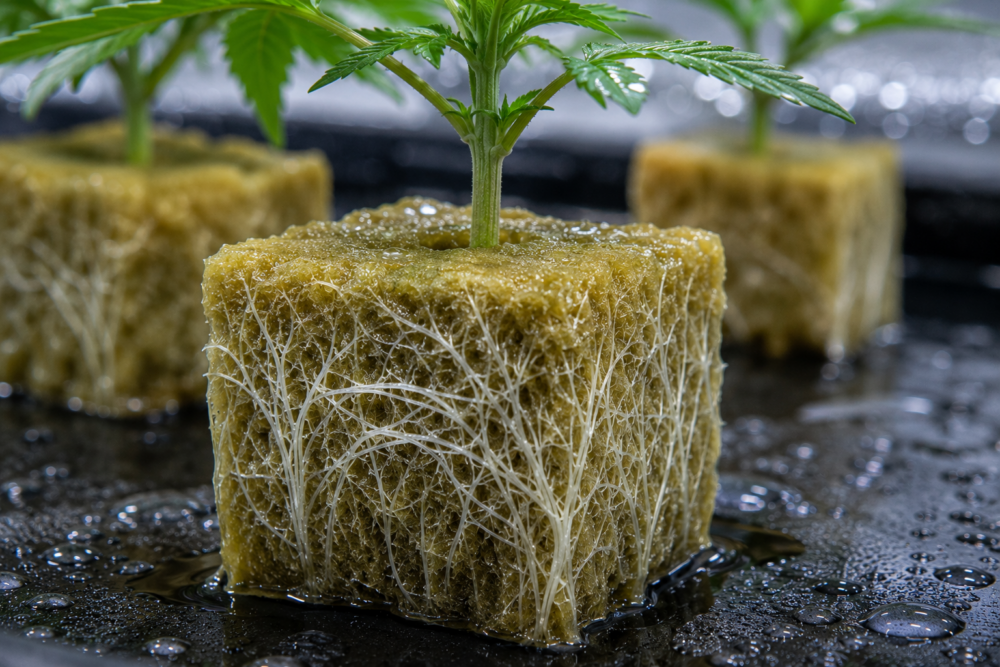
A cannabis clone will show signs such as white root tips, resistance to being lifted upwards, and new growth at the top.
Look for these signs before you assume rooting has failed:
- White, fibrous root tips visible through the drainage holes or rockwool cube
- Mild resistance when you gently tug the stem upward
- New leaf growth at the top of the cutting
- The cutting standing upright on its own instead of drooping
When to Transplant a Rooted Clone
Clones are ready to transplant once roots are visible on multiple sides of the cube or cup, generally 1 to 2 inches long.
Transplanting too early is one of the most common mistakes new growers make. Wait until roots have visibly spread rather than transplanting the moment you see the first white tip. If you bought your clones rather than cutting your own, our guide to buying cannabis clones covers what a healthy, ready-to-transplant clone should look like at the point of purchase.
What to Do If Rooting Is Taking Longer Than Expected
Rooting slowly is normally a result of low temperatures, humidity leaks, and movement of cuttings too soon after the cut, not because of genetics.
Before assuming the worst, check these first:
- Confirm the root zone temperature is at least 70°F
- Check that your humidity dome or cloner lid is sealing properly
- Avoid tugging on the cutting to “check” for roots more than once every few days
- Refresh rooting hormone if it has been more than a week with zero visible development
Slow rooting tests most growers’ patience. If the wait is wearing on you and you would rather have flower in hand while your clones catch up, weed delivery Sacramento can fill the gap with same-day product while you wait out the rooting process.
Rooting hormones work by supplying synthetic auxin, the plant hormone responsible for triggering root cell formation at a cut site. Cultivation resources such as Athena Agriculture’s cloning guide cover this process in more depth if you want to dial in your setup further, including cutting technique and rooting hormone strength.
FAQ
How long do cannabis clones take to root?
Cannabis clones take about 5 days to 3 weeks to root, depending on how you clone, but aeroponic cloners will be faster, while rooting in water is the slowest method.
When should I transplant a rooted cannabis clone?
Transplant once roots are 1 to 2 inches long and visible on multiple sides of the cube or cup, not at the first sign of a single root tip.
Why won’t my cannabis clone root?
The most common causes are a root zone that is too cold, a broken humidity seal, or disturbing the cutting too often to check on it, rather than a problem with the genetics.
What helps cannabis clones root faster?
Warm root zone temperatures around 72 to 78°F, high humidity, gentle indirect light, and fresh rooting hormone applied at the time of the cut all help speed up root development.
Do cannabis clones need 24 hours of light?
No. Clones root best under gentle, indirect light for 18 to 24 hours a day rather than intense direct light, which can stress a cutting that has no roots yet to support it.
Conclusion
At the end of the day, cloning is a bit of a patience game. Every grower has stared at a tray of cuttings wondering if today is the day roots finally show up, and more often than not, the answer is just to give it a few more days. Once you have cloned a strain or two, you start to get a feel for what normal looks like in your own setup, and the guessing gets a lot easier.
If you would rather start from a cut that has already been rooted and tested, browse our cannabis clones for sale.

